Introduction
Artificial Intelligence (AI) has transformed the way businesses create content. From blog posts and social media captions to product descriptions and email campaigns, AI tools can generate content in seconds. At the same time, human writers continue to play an important role in creating original, emotional, and engaging content.
This has created an important question for digital marketers, bloggers, and businesses: AI-generated content vs human-written content—which performs better in 2026?
The answer depends on your goals, target audience, content quality, and marketing strategy. Both approaches have advantages, and combining them can often produce the best results.
1. What Is AI-Generated Content?
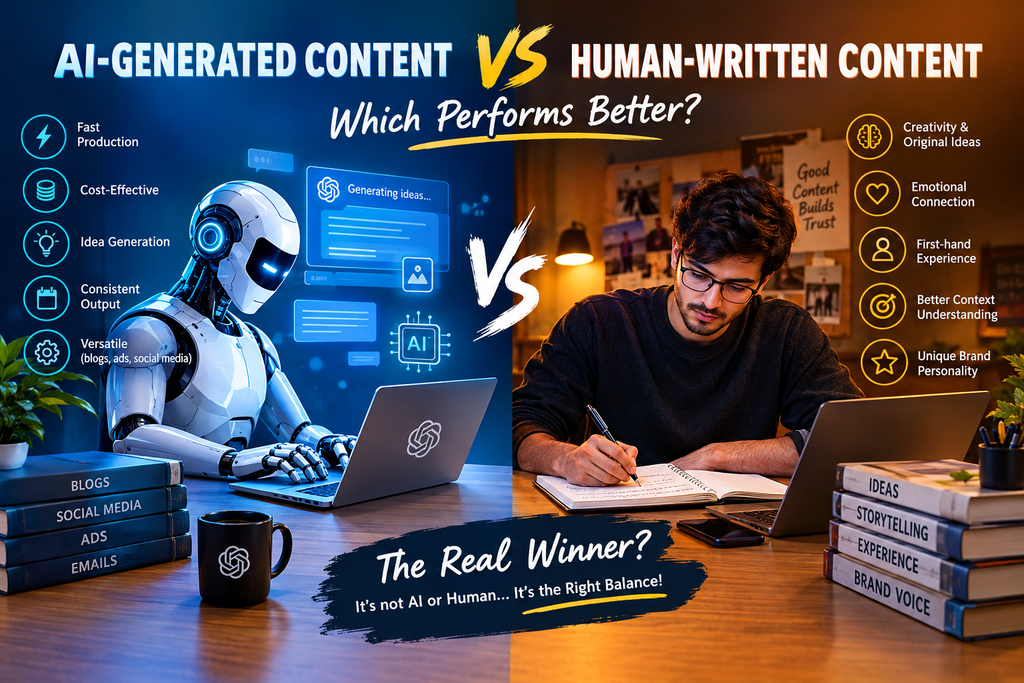
AI-generated content is text, images, videos, or other material created with the help of artificial intelligence tools. These tools use language models and other technologies to generate content based on user instructions, known as prompts.
Popular AI writing tools include ChatGPT, Google Gemini, and Grammarly’s AI features.
Advantages of AI-generated content:
- Speed: AI can create outlines, drafts, and captions within seconds.
- Cost-effectiveness: It can reduce the time and resources required for content production.
- Idea generation: AI helps marketers discover topics, keywords, and content angles.
- Consistency: It can help maintain a regular publishing schedule.
- Versatility: AI can assist with blogs, advertisements, emails, and social media posts.
However, AI-generated content may contain inaccurate information, repetitive language, or generic examples. It may also lack personal experiences and original insights unless the writer provides meaningful input.
2. What Is Human-Written Content?
Human-written content is created primarily by people using their knowledge, creativity, research, experience, and understanding of the audience.
Human writers can incorporate personal stories, expert opinions, cultural context, emotions, and real-world examples that make content more relatable.
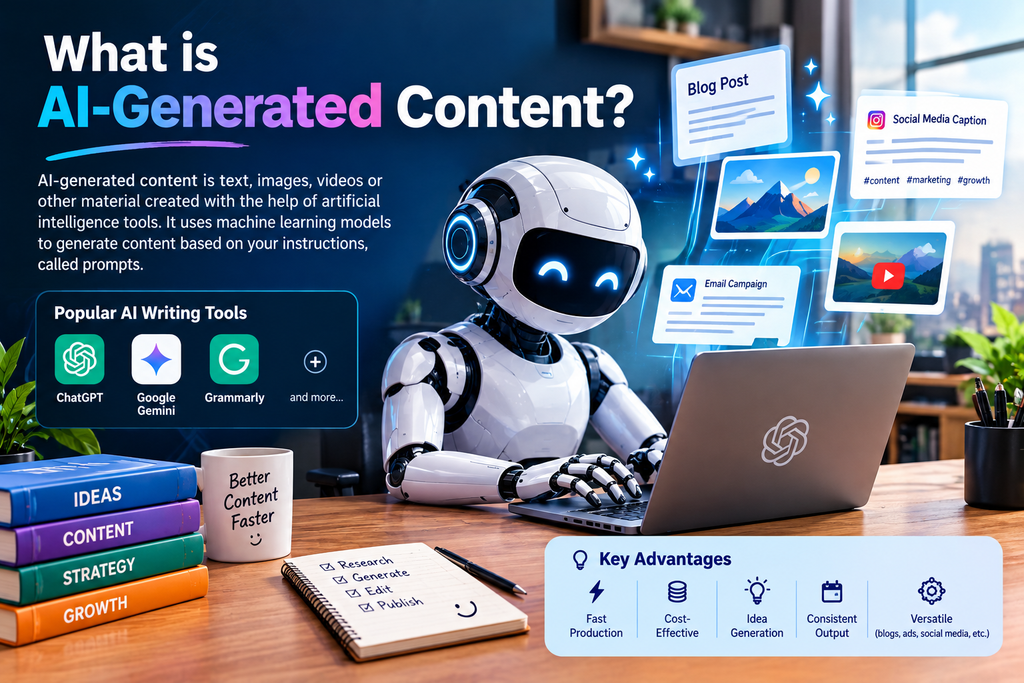
Advantages of human-written content:
- Creativity: Writers can develop distinctive ideas and engaging storytelling.
- Emotional connection: Human experiences can help build trust with readers.
- Original insights: Experts can share practical knowledge and first-hand experiences.
- Contextual understanding: Writers can better interpret complex situations and audience needs.
- Brand personality: Human writing can communicate a recognizable voice and identity.
Human-written content also has limitations. It may require more time, research, editing, and money. Maintaining a consistent publishing schedule can be challenging, particularly for small businesses and individual bloggers.

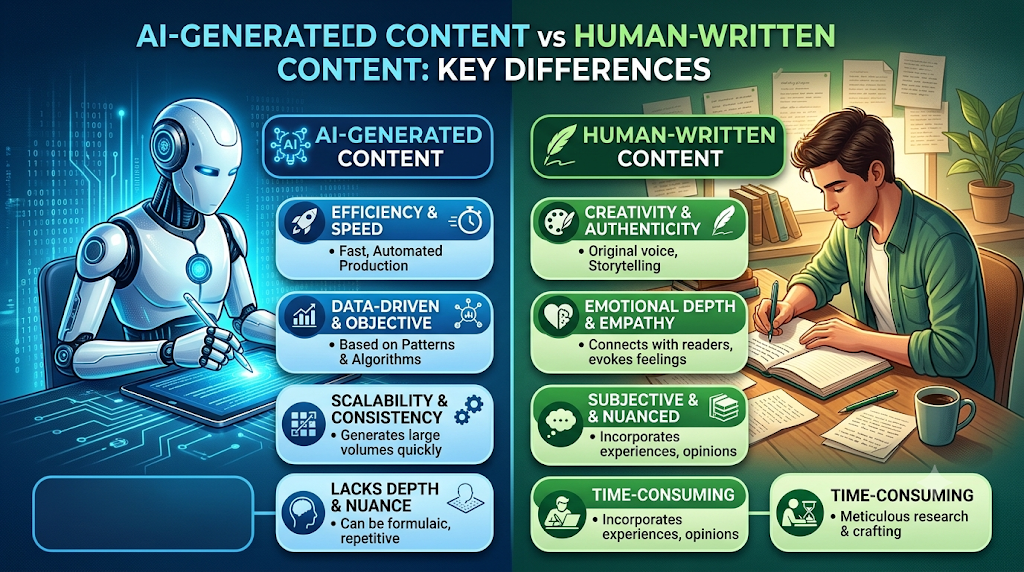
3. AI-Generated Content vs Human-Written Content: Key Differences
The following comparison highlights the main differences between the two approaches.
| Factor | AI-Generated Content | Human-Written Content |
|---|---|---|
| Speed | Very fast | Usually slower |
| Cost | Often lower per draft | Can be more expensive |
| Creativity | Depends on prompts and input | Strong in original storytelling |
| Accuracy | Requires fact-checking | Requires research and verification |
| Emotional connection | Can sound generic | Can reflect genuine experiences |
| SEO potential | Depends on quality and usefulness | Depends on quality and usefulness |
| Scalability | Easy to produce at volume | Limited by time and resources |
| Personal experience | Cannot independently claim lived experiences | Can draw on genuine experience |
Neither method automatically guarantees better performance. Results depend on how well the content serves the reader.